Increment tutorial: get your week scheduling itself
Beginner’s walkthrough. About 15 minutes.
Increment is a calendar that fills its own gaps. Tell it what has to happen and roughly how long it takes; it finds the time around the meetings you can’t move.
What this tutorial covers
The three kinds of thing
Everything in Increment is an event, a task, or a goal.
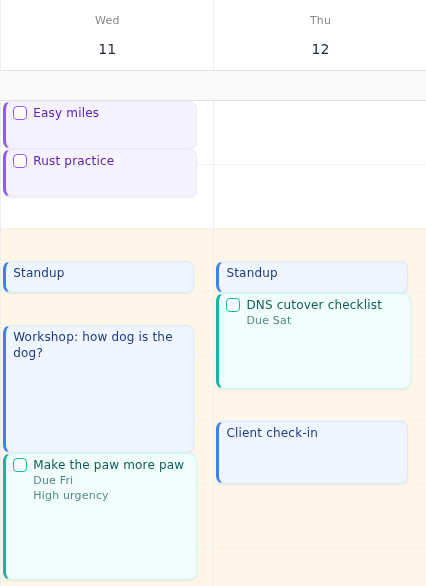
- Events are fixed. Meetings, appointments, trains. Increment never moves them.
- Tasks are flexible jobs and to-dos. Estimate the duration and Increment will find the best time to get them done.
- Goals are hours you want to spend repeatedly — gym, language, reading. They take what is left.
Blue for events, teal for tasks, violet for goals, everywhere in the app.
Bring in the calendar you already keep
Increment schedules around what is already booked. Two ways to tell it:
Option A — import an .ics file
A one-off snapshot. No account, nothing leaves your device. Export an .ics from Google Calendar, Outlook or Apple Calendar, then open the settings menu (the gear in the toolbar) and choose Import calendar…
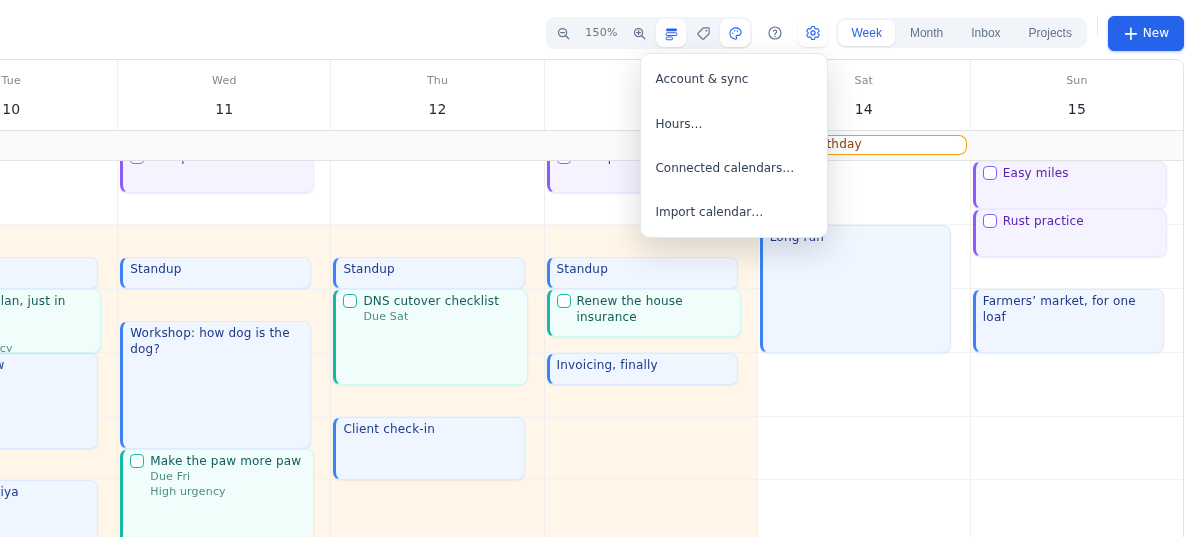
Repeating meetings, exceptions and cancellations are all understood. Re-importing the same file never duplicates anything.
Option B — connect Google Calendar or Outlook
A live link: meetings added later appear on their own. Needs an Increment account, because the credential is held on the server rather than in the app.
Settings menu → Connected calendars… → Connect. You give consent at Google or Microsoft and come back. Then tick which calendars count as busy.
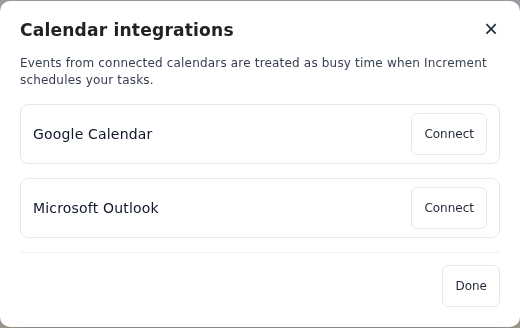
Google connections are limited right now. The integration sits in Google’s Testing publishing status: only addresses on our test-user list can connect, and Google expires those tokens after seven days, so the panel will say “Needs reconnecting” about weekly. Reconnecting costs one consent screen.
Outlook has no such gate, and .ics import works for everyone. Start there if you want the least friction today.
Connected calendars are read-only. Increment reads them to know when you are busy and never writes back.
Add your first task
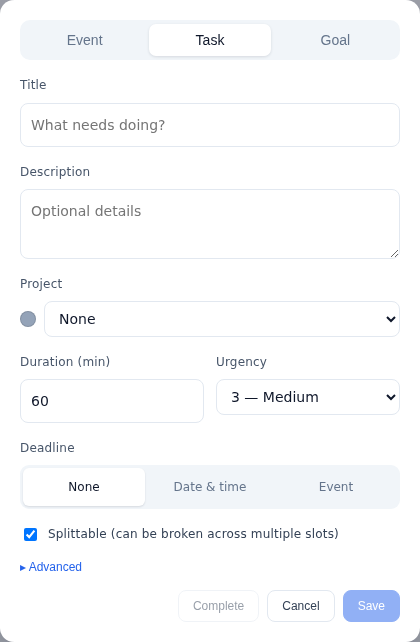
Press + New, top right. Three tabs — Event, Task, Goal. Pick Task.
Two fields do the work:
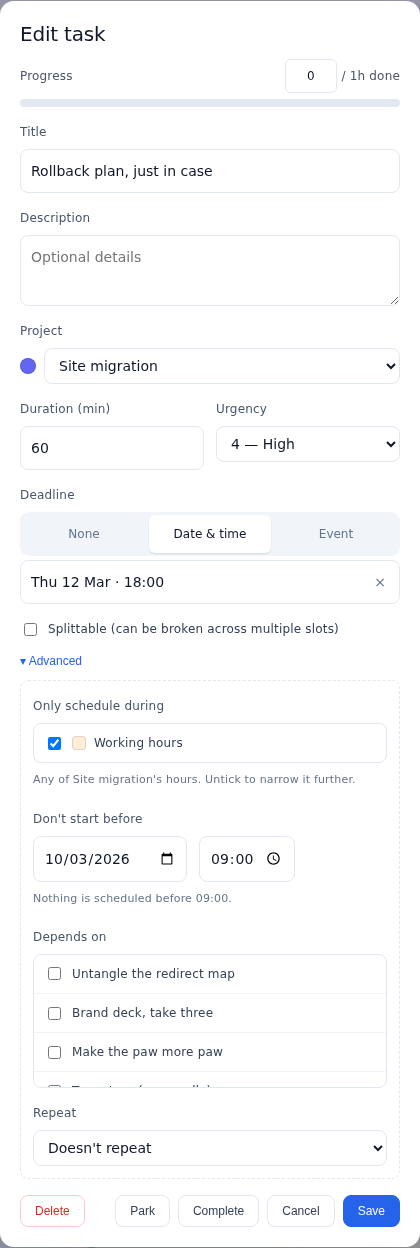
- Estimate (min) — how long the job takes. Guess; you can extend it later when Increment asks whether you finished.
- Deadline — a date and time, an event, or nothing.
Urgency runs 1 (Lowest) to 5 (Highest) and breaks ties between things due around the same time.
When you need more control
Advanced holds the rest: set repeated tasks, task dependencies, an earliest start date, and a minimum block size.
Press Reschedule and watch it fit
Reschedule sits at the top of the sidebar. Press it and your tasks and goals drop into the gaps between events, soonest deadline first, splitting anything too long for one block.
Scheduling only happens when you ask. Editing a task, logging time and changing an estimate all leave the week where it is.
Drag a block to move it, and dropping it pins it there. The rest of the week re-plans around it on the next press of Reschedule — not before, the same as any other edit.
Set the hours work may use
Left alone, Increment schedules into whatever time it can find. Hours are how you stop that: bands of the week, each one a period work may or may not be placed in. Settings menu → Hours…
A fresh install comes with three:
- Sleeping hours — 22:00 to 07:00, every day, never scheduled.
- Working hours — 09:00 to 17:00, Monday to Friday.
- Personal hours — the mornings, evenings and weekends around them.
Those three are a starting point, not a fixed set. Rename them, change their times and days, add as many as you want — a commute band, a study evening, Saturday mornings only.
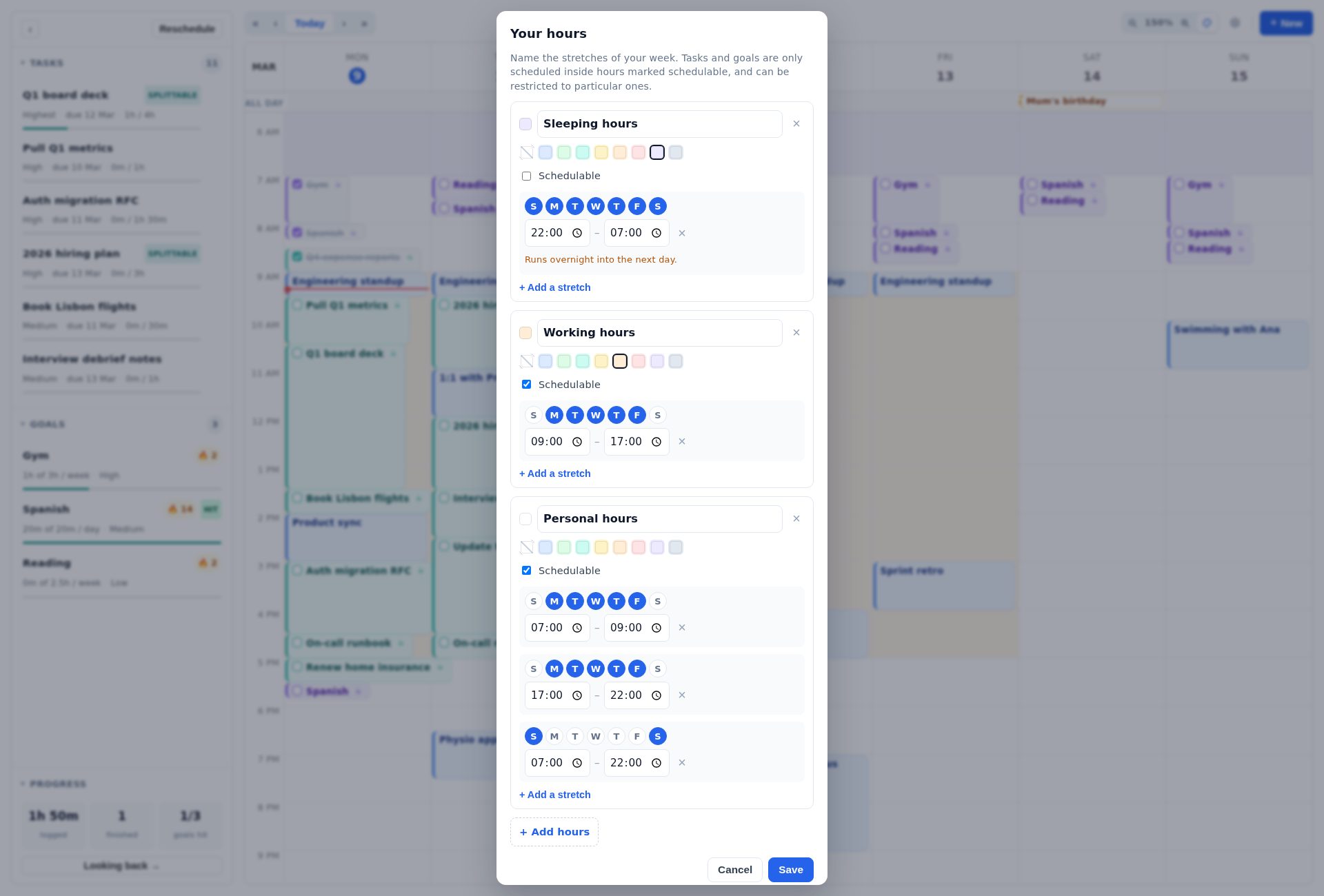
Bands become useful once you point work at them. Any task has an Only schedule during setting under Advanced: tick the bands it may use, and it will never be placed outside them. That is how the day job stays inside working hours and the gym stays outside them.
Setting this task by task gets tedious, which is what projects fix next.
Put related work in a project
In the item editor, open the Project dropdown and choose + New project… Tasks, events and goals can all be filed into one.
A project can carry its own hours, and they apply to everything filed inside it — so instead of restricting forty client tasks one at a time, you restrict the client project once. The two combine rather than override: a task’s own hours are narrowed by its project’s, never widened.
Projects also give you:
- A colour the whole calendar can take instead of blue-teal-violet, so a glance says where your time went.
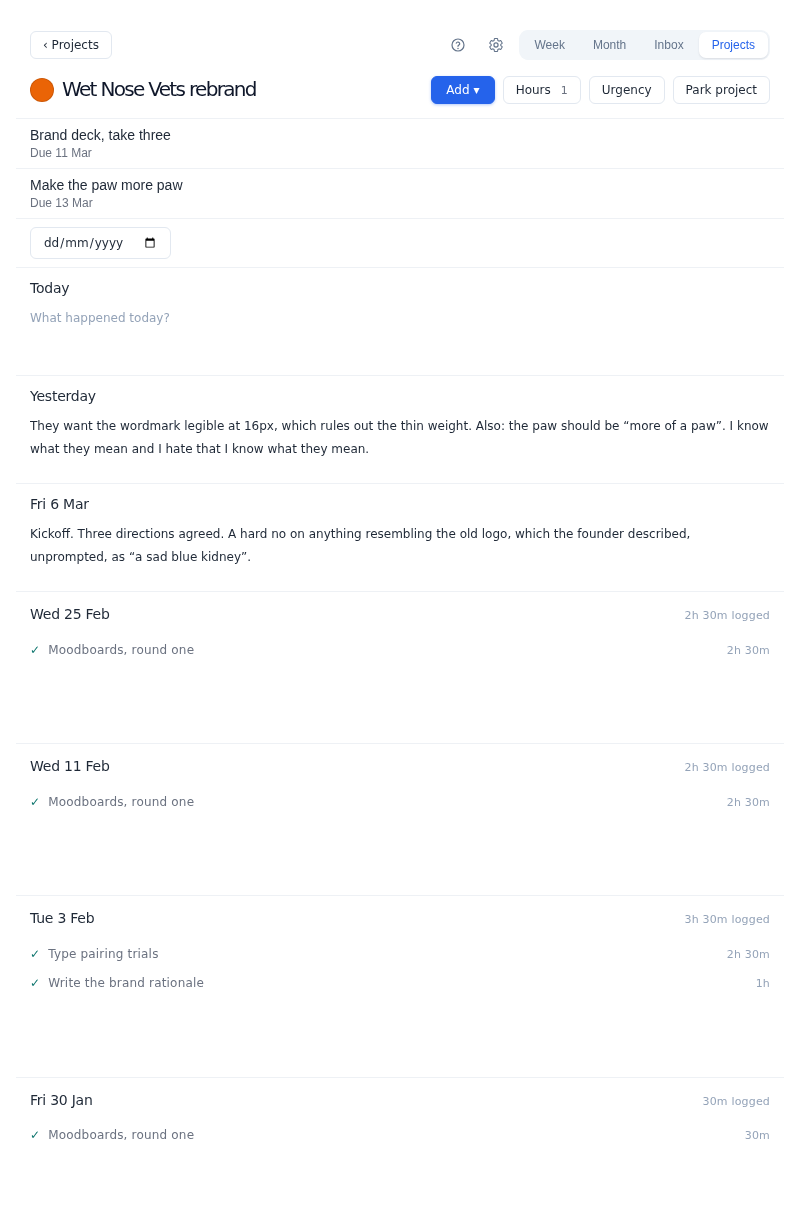
- A workspace: what is outstanding, a running log, and finished work filed under the day it happened with the time it took.
- A backlog. Send a project there and everything in it stops being scheduled — nothing is lost, and it all returns when you put it back in the plan. The button is labelled Park project. Single tasks and goals can go to the backlog too.
Set a goal that repeats
Goals are for what has no deadline but should keep happening. + New → Goal tab.
You describe a goal in sessions, not total hours: how many Sessions, Per day, week or month, and how long one runs under Session length (min). The line underneath does the arithmetic.
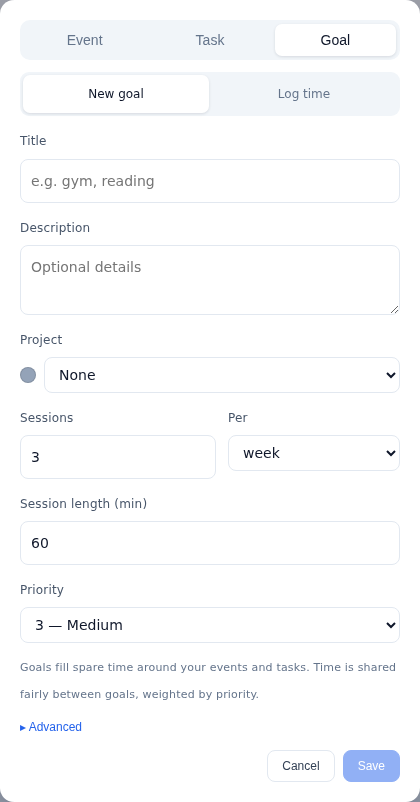
Goals fill the spare time around events and tasks, one session at a time. Time is shared between goals in proportion to priority.
A goal is not placed until it has a whole session banked, so a ten-minute gap gets skipped rather than filled with a fragment.
Tick sessions off from the sidebar as you finish. That feeds your streaks and the review.
What it costs
14 days free trial
Cancel whenever.
No recurring payment, and all future updates.
The £30 lifetime licence is one payment that never renews. The trial comes first either way, so you can find out whether auto-scheduling suits you before paying.
Or compare both plans. Billing is handled by Lemon Squeezy — any major card, Apple Pay or Google Pay.
Where to go next
- Looking back adds up what you did — by week, by goal, and as a year-long activity map.
- A lapsed licence does not lock you out. Increment goes read-only and nothing is deleted.
- It works offline, and syncs across devices if you sign in.
More on the thinking in Time Blocking Doesn’t Work (Until You Automate It), or see how to install Increment as an app.